Data integrity is the assurance that GxP data remains accurate, complete, consistent, and reliable throughout its entire lifecycle. Effective data integrity management requires oversight of every stage of data handling, including data generation, recording, processing, analysis, transformation, use, storage, retrieval, archival, and eventual destruction.
Maintaining data integrity ensures that all activities are properly controlled, documented, and traceable. As a result, records generated throughout the lifecycle adhere to the ALCOA and ALCOA+ principles, supporting the reliability and trustworthiness of GxP data.
To achieve and sustain data integrity compliance in paper-based, electronic, and hybrid systems, organizations must implement practical controls that ensure critical quality and business decisions can be verified, reviewed, and inspected at any point in the data lifecycle.
A risk-based approach should be applied when establishing data integrity controls. Organizations are expected to perform data integrity criticality and risk assessments to determine the appropriate level of technical, procedural, and organizational controls required to protect data and ensure product quality, patient safety, and regulatory compliance.
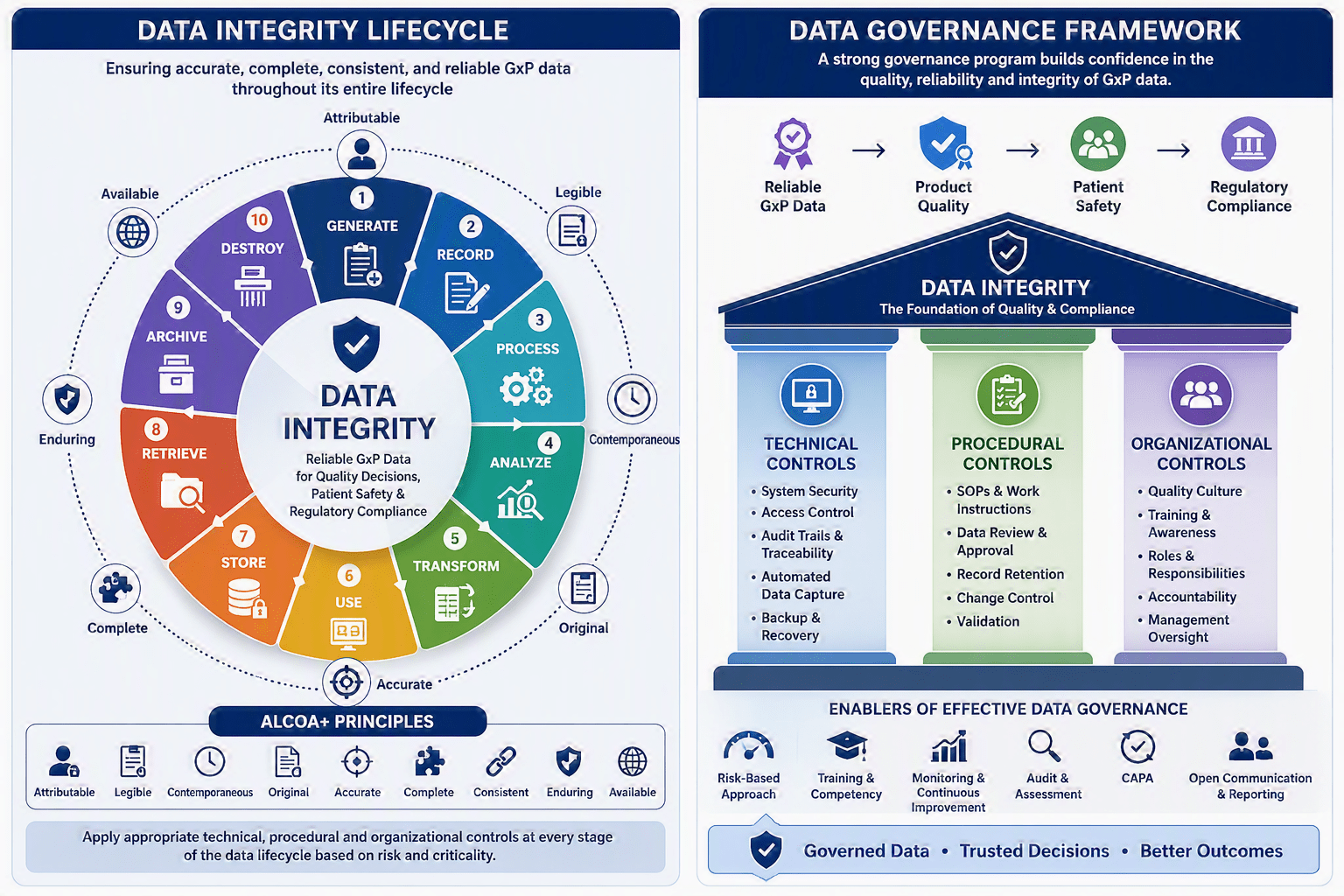
Importance of Data Governance
A strong data integrity program extends beyond procedures and technology. It requires a quality-focused culture and a working environment that promotes ethical behavior, accountability, transparency, and compliance.
Organizations should establish a comprehensive data governance program that addresses:
Technical controls for data protection and security
Procedural controls for data creation, review, and retention
Behavioral expectations that promote ethical conduct and data ownership
Roles and responsibilities related to data management
Training and awareness programs to reinforce data integrity principles
Monitoring and continuous improvement activities
An effective data governance framework builds confidence in the quality, reliability, and integrity of data used to support GxP activities and regulatory decisions.
Foundational Principles of Data Governance
Key principles that support an effective data governance program include:
Management Commitment – Leadership should actively support and promote data integrity throughout the organization.
Defined Roles and Responsibilities – Personnel should clearly understand their responsibilities for data creation, review, approval, and maintenance.
Data Lifecycle Management – Controls should be established for all stages of the data lifecycle.
Risk-Based Controls – Data integrity controls should be proportional to the criticality and risk associated with the data.
Training and Competency – Employees should receive ongoing training on data integrity requirements and expectations.
System Security and Access Control – Appropriate measures should be implemented to protect data from unauthorized access, modification, or deletion.
Audit Trails and Traceability – Changes to data should be recorded, reviewable, and attributable to the individual performing the activity.
Continuous Monitoring and Improvement – Regular assessments should be conducted to identify gaps and strengthen the effectiveness of the data governance program.
Foundational Principles of Data Governance
1. Organizational Culture
Organizational culture plays a critical role in maintaining data integrity. A poor culture can increase the risk of both intentional data integrity breaches, such as falsification or fraud, and unintentional errors resulting from inadequate knowledge or understanding of responsibilities.
To support data integrity, organizations should foster an open and transparent work environment where:
Employees are encouraged to raise concerns without fear of retaliation.
Open communication is promoted across all organizational levels.
Personnel can challenge decisions when data integrity risks are identified.
Reporting of errors, deviations, and system weaknesses is considered a normal business expectation.
Continuous improvement and learning are encouraged.
A positive quality culture helps prevent data integrity issues and supports regulatory compliance.
2. Awareness
Data integrity is the responsibility of every employee involved in GxP activities. Personnel must understand the importance of maintaining accurate, complete, and reliable records and recognize how their actions can affect data quality.
Organizations should establish awareness programs that:
Educate employees on data integrity principles and expectations.
Explain individual responsibilities related to data creation, review, modification, and approval.
Provide periodic refresher training to maintain knowledge and compliance.
Promote understanding of ALCOA+ principles and their practical application.
Reinforce company policies and procedures related to data governance and record management.
Regular training and awareness initiatives help ensure that employees consistently apply data integrity requirements in their daily activities.
3. System and Process Design
Systems and processes should be designed to support and simplify compliance with data integrity requirements. Well-designed processes reduce the opportunity for errors and improve data reliability.
Examples of effective system and process controls include:
Controlled issuance and management of blank paper templates used for GxP data recording.
Management and validation of spreadsheets used for calculations and data processing.
Availability of accurate clocks and timing devices for recording time-sensitive activities.
Easy access to records at the locations where activities are performed.
User access levels and permissions aligned with assigned job responsibilities.
Automated data capture wherever feasible to minimize manual entry errors.
Appropriate access to electronic records for personnel performing review and approval activities.
Standardized workflows that ensure data is captured, reviewed, and retained consistently.
Effective process design promotes accuracy, efficiency, and compliance throughout the data lifecycle.
4. Management Commitment
Senior management plays a vital role in establishing and sustaining a strong data integrity program. Leadership should demonstrate a clear commitment to quality, compliance, and good data management practices.
Management responsibilities include:
Supporting and promoting an open quality culture.
Establishing and maintaining data integrity governance processes.
Providing adequate resources, personnel, and technology to support compliance.
Ensuring employees receive appropriate data integrity training.
Monitoring data integrity performance through reviews, audits, and assessments.
Implementing corrective and preventive actions (CAPA) to address identified issues.
Establishing mechanisms that enable employees to report concerns or potential data integrity issues.
Reinforcing accountability for maintaining reliable and trustworthy GxP data.
Strong management commitment helps create an environment where data integrity is embedded into everyday operations and business decision-making.